What ISO 13485 is for
ISO 13485 is the international standard for quality management systems in the medical device sector. Where ISO 9001 focuses on customer satisfaction and improvement, ISO 13485 focuses on consistently providing medical devices that are safe and perform as intended, and on meeting the regulatory requirements that apply to them.
It is used by organisations involved at any stage of a medical device's life: design and development, manufacturing, sterilisation, storage and distribution, installation, servicing, and the supply of components and services. Regulators and customers in many markets treat it as the expected basis for a medical device quality system.
ISO 13485 follows its own structure rather than the common high-level structure, but its topics map well onto ISO 9001, ISO 14001, ISO 45001 and ISO 22000, so it can sit inside an integrated management system.
The main requirements in plain language
- Quality management system (clause 4). Document the system and the role your organisation plays, apply a risk-based approach to process control, control outsourced processes, and validate software used in the system (4.1). Keep a medical device file for each device type (4.2.3), control documents (4.2.4) and records (4.2.5).
- Management responsibility (clause 5). Top management commits to the system and to regulatory compliance, sets a quality policy and objectives, appoints a management representative, and reviews the system at planned intervals (5.6).
- Resource management (clause 6). Competent and trained people with documented effectiveness checks (6.2), suitable infrastructure (6.3), and a controlled work environment and contamination control (6.4).
- Product realisation (clause 7).
- Plan realisation with risk management throughout (7.1).
- Determine and review product requirements and communicate with customers and regulators (7.2).
- Control design and development, including verification, validation, transfer and changes (7.3).
- Evaluate and select suppliers using criteria in proportion to the risk of what they supply, and monitor them (7.4).
- Control production and service, including cleanliness, installation, servicing, process validation, identification, traceability and preservation (7.5), and control monitoring and measuring equipment (7.6).
- Measurement, analysis and improvement (clause 8).
- Gather feedback (8.2.1), handle complaints in a documented and timely way (8.2.2), and report to regulatory authorities where required (8.2.3).
- Run internal audits (8.2.4) and monitor processes and product.
- Control nonconforming product (8.3), analyse data (8.4), and take corrective action (8.5.2) and preventive action (8.5.3).
How helps today
Each company can switch on ISO 13485 alongside ISO 9001. Today ItqanMS covers the core quality system processes:
- Document control (4.2.4): a register with document numbers, revisions, approval before release, review dates with reminders, superseded and withdrawn status, and access by role and department.
- Supplier controls (7.4): an approved supplier list, scored evaluations with approval, re-evaluation frequency set by criticality, certificate expiry reminders, supplier issues and supplier audits.
- Complaints and nonconforming product (8.2.2, 8.3): record complaints and nonconformities, classify them by severity, and route them for approval.
- Corrective and preventive action (8.5.2, 8.5.3): 5 Whys root cause analysis, actions with owners and reminders, and verification of effectiveness with evidence.
- Risk-based approach (4.1): a risk register on your own likelihood × impact matrix for process and system risks.
- Quality objectives and data analysis (5.4, 8.4): KPIs with targets, green/amber/red status and trends.
- Records and software used in the quality system (4.2.5, 4.1.6): an audit trail that keeps the value before and after every change, approvals signed with the person's password, and a validation report on request to support your own validation of ItqanMS.
- Internal audit and management review (8.2.4, 5.6): ISO 13485 checklists, findings that become issues, and a review inputs pack filled from every module.
Medical device register
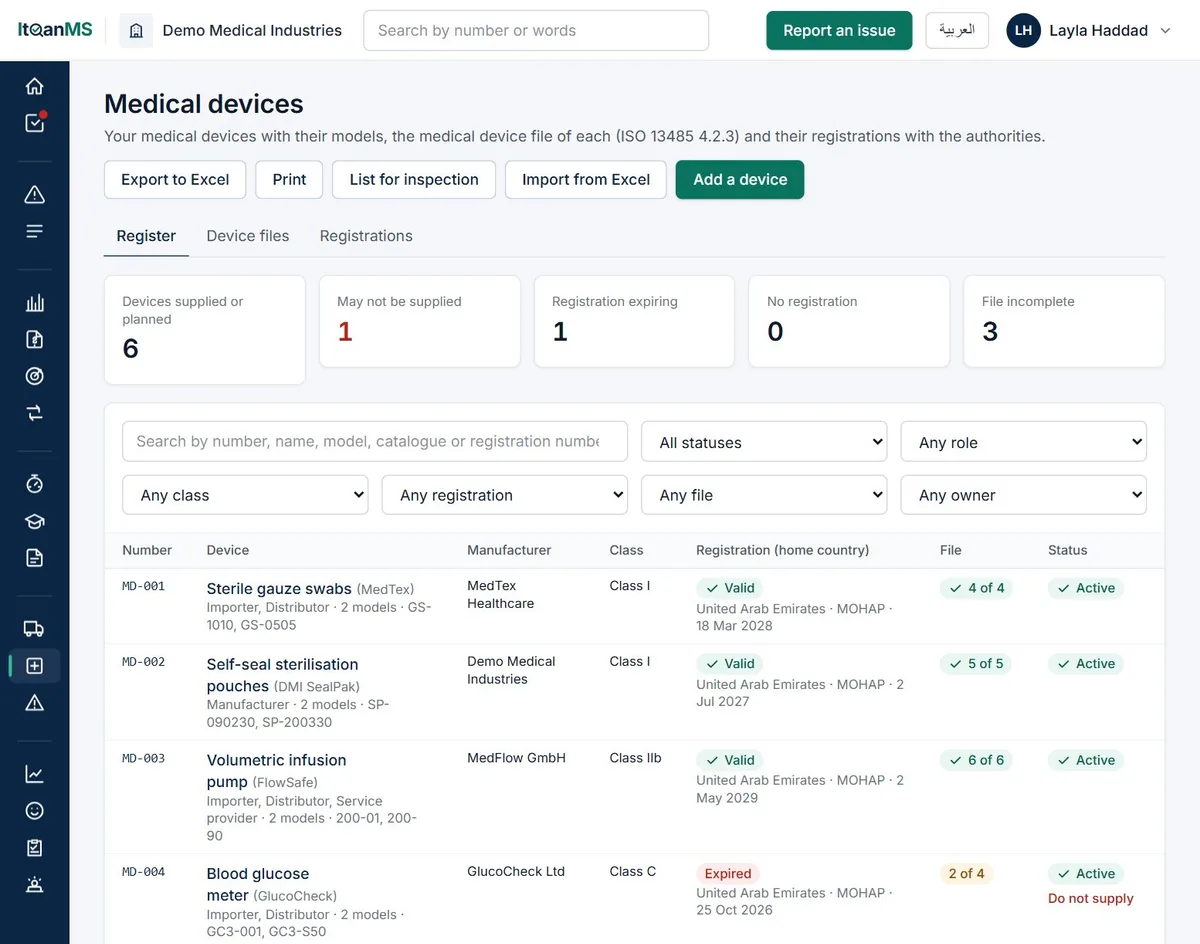
Every device and device family in one register, with its models, REF and UDI-DI. Keep each medical device file complete, part by part (ISO 13485 4.2.3), and track registrations by country with reminders before they expire.
More is coming
More dedicated medical device features are coming. ItqanMS does not currently provide recall management or direct reporting to regulators.
A note on certification
Certification is granted by independent certification bodies. ItqanMS supports your medical device quality system and keeps your records organised; it does not replace your organisation's responsibility for device safety and regulatory compliance.